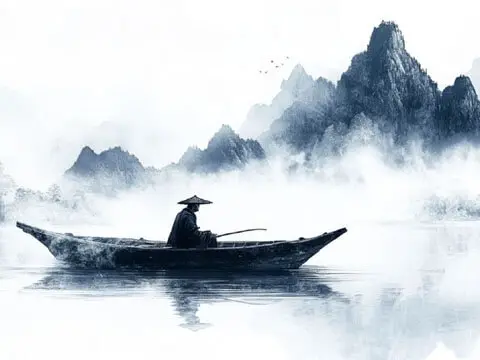
Huaigu Poetry: Meditations on the Ruins of Time
To understand the Chinese poetic mind is to understand its obsession with history. Huaigu Poetry (怀古诗, Huáigǔ Shī—literally “cherishing antiquity” or “meditating on the past”) is a colossal genre dedicated entirely to the melancholy of standing before the ruins of forgotten empires.
The Topography of Memory
A classic Huaigu poem follows a specific emotional choreography. The poet arrives at a historically significant location—an ancient battlefield like Red Cliff, the overgrown ruins of a former capital, or an old ferry crossing. They look at the physical landscape (the mountains, the river, the autumn weeds) and contrast its eternal permanence with the terrifying brevity of human glory.
Su Shi’s masterpiece, Memories of the Past at Red Cliff (念奴娇·赤壁怀古), perfectly captures this essence. Staring at the Yangtze River, he writes: “The Great River flows east, / Its waves washing away / All the gallant heroes of a thousand ages.”
The Tragic Contrast (物是人非)
The aesthetic core of Huaigu is Wu Shi Ren Fei (物是人非): “The objects remain, but the people are gone.”
Poets frequently employ specific imagery to evoke this sorrow:
- Sunset and Twilight (夕阳/斜阳): Symbolizing the fading glory of a dynasty.
- Weeds and Wild Grass (芳草/荒草): Representing nature reclaiming the most luxurious imperial palaces.
- The Uncaring Moon (明月): The exact same moon that shone on the legendary emperors now shines coldly on the ruins, entirely indifferent to human suffering.
Huaigu poetry offered Chinese intellectuals a cosmic comfort. By recognizing that even the greatest emperors and heroes are eventually swallowed by the dust of time, their own personal failures and political exiles suddenly felt much lighter to bear.