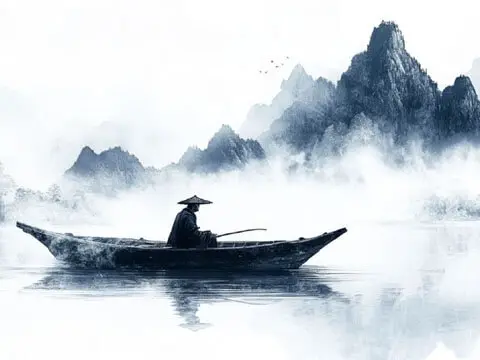
The Landscape and Pastoral School: Finding the Cosmos in Nature
When Western readers envision classical Chinese poetry, they often picture a solitary figure standing amidst misty mountains, listening to a temple bell, or drinking wine beneath a pine tree. This globally recognized aesthetic was explicitly engineered by the Landscape and Pastoral School (山水田园诗派, Shānshuǐ Tiányuán Shīpài) of the Tang Dynasty.
This poetic school was the ultimate rebellion through retreat. Instead of seeking glory in the imperial court or on the battlefield, these poets sought enlightenment, peace, and spiritual purity in the wilderness.
The Twin Pillars: Wang Wei and Meng Haoran
While the tradition traces its roots back to the “Fields and Gardens” poetry of Tao Yuanming (陶渊明) in the 4th century, it reached its absolute zenith in the High Tang under two inseparable friends: Wang Wei (王维) and Meng Haoran (孟浩然). Together, they are known in literary history simply as Wang-Meng.
Meng Haoran: The Pure Recluse
Meng Haoran spent almost his entirely life without an official government title. He wandered through mountains and rivers, writing poetry purely for the joy of it. His verses are incredibly natural, lacking any forced philosophy. His famous poem Spring Dawn (春晓) captures the simple, fleeting beauty of waking up to birdsong and wondering how many blossoms fell during the night’s storm.
Wang Wei: The Poet Buddha (诗佛)
Wang Wei, a devout follower of Chan (Zen) Buddhism, brought a mystical depth to the school. He was not only a master poet but also a legendary painter and musician. The Song Dynasty genius Su Shi later praised him, saying: “There is painting in his poetry, and poetry in his painting.”
Wang Wei’s poems often end in profound emptiness (空灵). In his verses, the human ego dissolves completely into nature. He writes of empty mountains where no men are seen, only the echoes of distant voices and sunlight filtering through deep moss.
The Aesthetic of Quietude
The Landscape and Pastoral School avoided the grand political tragedies of their time. Instead, they focused on Jing (静)—profound quietude. They utilized imagery of white clouds, flowing water, bamboo groves, and setting suns to represent Daoist naturalism and Buddhist emptiness.
Through their words, nature ceased to be a mere background setting; it became the ultimate teacher, the healer of the human soul, and the mirror of the universe.