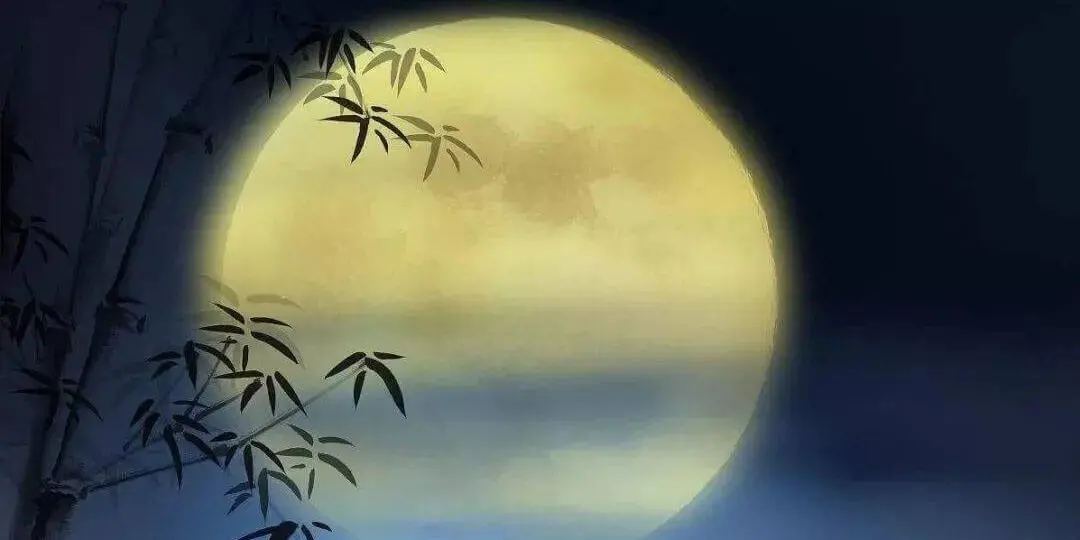
The Bright Moon: A Cosmic Mirror for Homesickness
If you were to count the most frequently used words in the Complete Tang Poems (a collection of nearly 50,000 poems), the word “Moon” (月) would undeniably be near the very top.
In classical Chinese culture, the moon transcends astronomical reality. It is a messenger, a companion, a philosophical focal point, and above all, the ultimate symbol of homesickness.
1. The Shared Sky: A Network of Emotion
In an era without modern communication, families and friends separated by thousands of miles had no way of knowing if the other was safe. The moon provided the only shared visual connection.
When a lonely traveler looked up at the full moon from a frontier fortress, they knew that their family back in the capital was looking at the exact same moon. The moonlight acted as a cosmic network, carrying thoughts and longing across impossible distances.
This sentiment reached its philosophical peak during the Song Dynasty, when Su Shi (苏轼) wrote his immortal lines during the Mid-Autumn Festival:
May we all be blessed with longevity, Though thousands of miles apart, we share the beauty of the same moon. (但愿人长久,千里共婵娟)
2. Li Bai: The Moon’s Closest Friend
No poet is more closely associated with the moon than the “Immortal Poet,” Li Bai. For him, the moon was not just a distant object, but a living companion.
In his famous poem Drinking Alone Under the Moon, he cures his profound isolation by inviting the moon and his shadow to form a party of three. And in his universally memorized Quiet Night Thought, the moonlight is so bright it is mistaken for frost on the floor—a chilling visual that instantly triggers his homesickness.
Legend even states that Li Bai died by drowning in the Yangtze River because he tried to embrace the moon’s reflection in the water—a fittingly romantic end for a man obsessed with its ethereal beauty.
3. The Symbol of Eternity vs. Human Transience
The moon is also used to emphasize the fleeting nature of human life. The moon waxes and wanes, yet it is eternal. Empires rise and fall, humans grow old and die, but the moon shining over the Yangtze River tonight is the same moon that shone on the ancients thousands of years ago.
Zhang Ruoxu, in his epic Spring River in the Flower Moon Night, asks the ultimate existential question:
Who by the riverside first saw the moon? When did the river moon first shine on a man?
The bright moon, therefore, is not merely beautiful. It is a gentle yet melancholic reminder of our temporary place in the universe.