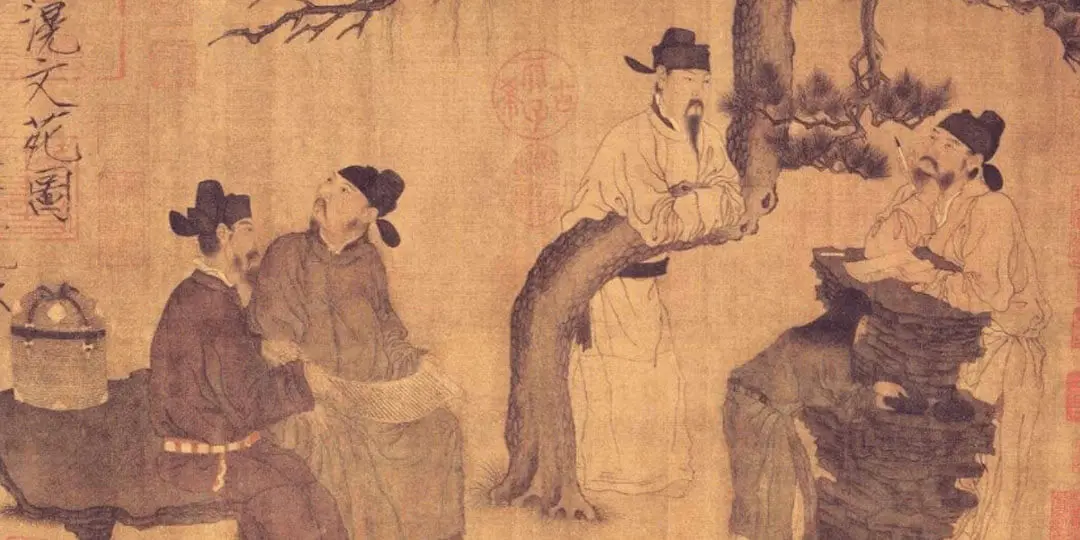
The Four Masters of Early Tang: Pioneers of a Golden Age
Before Li Bai and Du Fu could elevate Tang poetry to its absolute zenith, the groundwork had to be laid by a group of rebellious young geniuses known as the Four Masters of Early Tang (初唐四杰, Chū Táng Sì Jié).
Comprising Wang Bo (王勃), Yang Jiong (杨炯), Lu Zhaolin (卢照邻), and Luo Binwang (骆宾王), this collective lived during the 7th century. They share a striking historical footprint: all were celebrated child prodigies, all possessed towering arrogance and ambition, and tragically, all suffered dramatic, premature downfalls.
Breaking the Chains of Court Poetry
During the early Tang Dynasty, the literary scene was still dominated by the “Palace Style” (宫体诗) inherited from the preceding Six Dynasties. This style was highly formal, decorative, and obsessed with describing banquets, women, and palace architecture. It was beautiful but lacked a soul.
The Four Masters despised this superficiality. They sought to infuse poetry with genuine human emotion, sweeping landscapes, and the harsh realities of frontier life. By expanding the subject matter of poetry from the inner palace out into the vast world, they effectively ignited the poetic revolution that would become the Golden Age of the Tang Dynasty.
The Four Prodigies
1. Wang Bo (王勃): The Doomed Genius
Considered the leader of the four, Wang Bo wrote the immortal prose-poem Preface to the Pavilion of Prince Teng (滕王阁序) in his early twenties. His lines, “A bosom friend afar brings a distant land near” (海内存知己,天涯若比邻), remain the most famous farewell verses in Chinese history. Tragically, Wang Bo drowned in the South China Sea while traveling to visit his exiled father. He was only 26.
2. Luo Binwang (骆宾王): The Rebel Wordsmith
Famous for writing Ode to the Goose (咏鹅) at the age of seven, Luo Binwang’s life took a radical turn when he drafted a legendary, blistering manifesto against Empress Wu Zetian. The Empress herself was said to be so impressed by the brilliance of his writing that she scolded her ministers for letting such a talent slip into the rebellion. He disappeared after the rebellion failed, his fate unknown to this day.
3. Lu Zhaolin (卢照邻) & Yang Jiong (杨炯)
Lu Zhaolin expanded the scope of seven-character ancient verse, capturing the dazzling but chaotic street life of the capital, Chang’an. However, afflicted by a severe, incurable illness, he ultimately ended his own life by leaping into a river. Yang Jiong, slightly more fortunate in his career, pioneered the “Frontier Poetry” (边塞诗) subgenre, romanticizing the perilous lives of soldiers stationed at the edges of the empire.
Legacy in the Lore
The Four Masters of Early Tang were not a formal society but a historical grouping united by their shared aesthetic vision and tragic destinies. They lived fast, died young, and left behind a transformed literary landscape. Without their courage to dismantle the ornate, hollow styles of the past, the magnificent cosmos of High Tang poetry might never have existed.