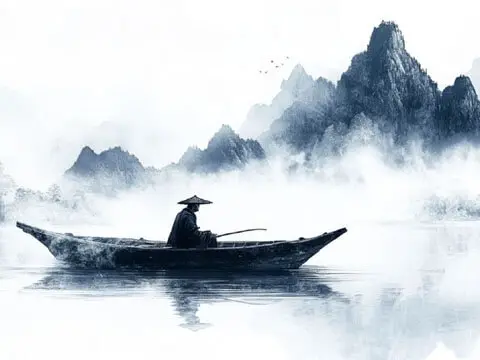
Spring River in the Flower Moon Night: The Crown of Tang Poetry
The Tang Dynasty produced nearly 50,000 recorded poems and gave birth to immortal titans like Li Bai and Du Fu. Yet, in the eyes of many modern literary critics, the absolute zenith of this golden age belongs to a single, mesmerizing poem written by a man about whom history knows almost nothing: Zhang Ruoxu (张若虚).
His masterpiece, Spring River in the Flower Moon Night (春江花月夜, Chūn Jiāng Huā Yuè Yè), is universally hailed by Chinese scholars with a jaw-dropping title: “A single poem that crowns the entire Tang Dynasty” (孤篇盖全唐).
The Five Perfect Elements
The title itself is considered a miracle of the Chinese language, seamlessly weaving together the five most beautiful elements of the physical world: Spring (春), River (江), Flowers (花), Moon (月), and Night (夜).
In 36 flawless lines, Zhang Ruoxu creates a cinematic, dreamlike atmosphere. He describes a massive tidal river shimmering under the moonlight, where the boundaries between the sky, the water, and the white frost completely dissolve into a single, glowing cosmic expanse.
A Cosmic Question
However, it is not just a beautiful landscape poem. Midway through, Zhang shifts his gaze from the river to the universe itself, asking a series of profound, existential questions that echo through eternity:
“Who along the riverbank first saw the moon? / When did the river’s moon first shine upon a man?” (江畔何人初见月?江月何年初照人?)
He reflects on the terrifying brevity of human life compared to the eternal cycles of the moon and the river. Yet, instead of plunging into the deep melancholy typical of earlier Huaigu (historical reflection) poetry, Zhang arrives at a beautiful, comforting realization. Individual lives are short, but humanity as a whole flows endlessly onward, just like the Yangtze River, forever illuminated by the same moon.
The Ultimate Milestone
Spring River in the Flower Moon Night stands as the ultimate milestone because it perfectly bridged the gap between the ornate, decorative styles of the past and the grand, philosophical, and sweeping cosmos of the High Tang era. It remains the most mesmerizing symphony ever composed in Chinese characters.